
Investor deck · October 2026
Run your company from one conversation.
Supernatural is an AI workspace for founders. Its agent, Blue, works across mail, calendar, files, projects, contracts, invoices and support. You say what needs doing. Blue shows a plan. You approve. Every app updates.
Rang & Mall Private Limited · Visakhapatnam, India · supernatural.freedomlabs.in
The problem
The founder is the integration.
A ten-person company runs mail, a calendar, files, projects, contracts, invoices, support, a CRM, HR and payroll. Ten logins. Ten bills. No shared memory.
Every morning the founder reads one app, retypes it into the next, and remembers what the third one does not know.
A company under 50 people runs about 16 SaaS apps (BetterCloud survey, 2020). The count has only grown since.
7:58 AM, any Monday
- CInvoicingInvoice INV-0042 is 9 days late.
- SE-signatureAcme signed the contract.
- PChatA customer is upset. Call notes inside.
Three apps. Three tabs. One person to connect them. The chase mail, the project folder and the kickoff meeting are all still to be made by hand.
The product
One agent. One data plane. 31 capabilities.
Blue is the agent. Each app is a capability it can use: the same screen as a tile in the chat and as a full app on its own route.
- Reads run free. Ask what is late, who signed, what is due.
- Writes show a plan. Every step, every argument, the events it will record.
- You confirm. One click, and every app updates. Nothing runs before that.
Plan
These steps have not run. Review them, then confirm or reject.
Steps (3)
- 1drivefolder create
drive.folder_create- name
- Contracts
- parent
- Acme
- 2chronosmeeting schedule
chronos.meeting_schedule- title
- Acme kickoff
- starts at
- Tuesday 10:00
- attendees
- 3
- 3atlasproject create
atlas.project_create- name
- Acme onboarding
- tasks
- 6
Predicted result
would create
- folder
- Acme / Contracts
- meeting
- Acme kickoff, Tuesday 10:00
- project
- Acme onboarding
Events this would record
How a sentence becomes work
Seven steps, none of them guesswork.
- Resolve entities"Acme" becomes one org id before anything else runs.
- Route on capability cardsEach app publishes a card. The router picks two to four, never all 31.
- Load those toolsetsOnly the tools that matter for this sentence reach the model.
- Plan and confirmWrites come back as a plan with a predicted result. You confirm or reject.
- Call the toolsTyped tools in, typed results out. Every capability speaks the same wire.
- Record and fan outEvery change is an event. Rules, not the model, decide what follows, with the cause recorded.
- Show the tileThe result lands in the chat. Click it and it is the app.
Why it holds together
Trust is built in, not prompted in.
Apps never talk to apps
They meet in shared entities. "Unpaid customers we have not spoken to" is a join across orgs, invoices and messages, not a conversation between four apps in four dialects.
Events and rules, not the model
One event fans out through a rule engine, deterministically, with the cause recorded. The model handles one intent per turn and never becomes the glue.
Ten laws the product obeys
Written down before the code, listed on the next slide. Law 6 alone: never chase a customer over a thread a human is already on. Auto-execute is a permission matrix per tenant, every switch off by default.
Tenant data sits under forced row-level security in the database itself, on 48 tables in the current migrations. Encrypted in transit and at rest.
The ten laws
What Blue may never do, written before the code.
- Events are facts, not commands.An event says what happened. Each app decides its own reaction. A new app is a new subscriber, and nothing that emits changes.
- Exactly-once effects on at-least-once delivery.Every reaction is idempotent. A redelivered event is harmless. An app that was down replays its backlog and converges.
- Reads free, writes planned.Any read runs at once. Any write is shown as a plan. A chain across apps confirms once, not per step.
- Human edits pin.A date, owner or amount a person set is never silently overridden. Blue may propose. The pin holds until a human releases it.
- Money and signatures are gated.Invoices issue only after a contract is executed. Sent invoices and signed contracts are immutable. Corrections are new artifacts.
- Never robo-talk over a human conversation.Any automated outbound checks for recent human messages on that thread and yields. The window is per tenant.
- Blocking versus eventual is explicit.Three reactions block: pinning a signed contract, issuing credentials, revoking access when a person leaves. Everything else is eventual, with its pending state visible.
- The event log is the product's memory.Append-only, tenant-scoped, never holding a secret. What happened, who did it and why is a query.
- Provenance on everything.Every row knows whether an agent or a human wrote it, from which event, from which sentence. Trust is inspectable.
- Cascades are bounded.Five steps deep from any root event. A reaction that would go further parks as a proposed action. No loops, no storms.
A day with Blue
Four sentences. Four apps updated.
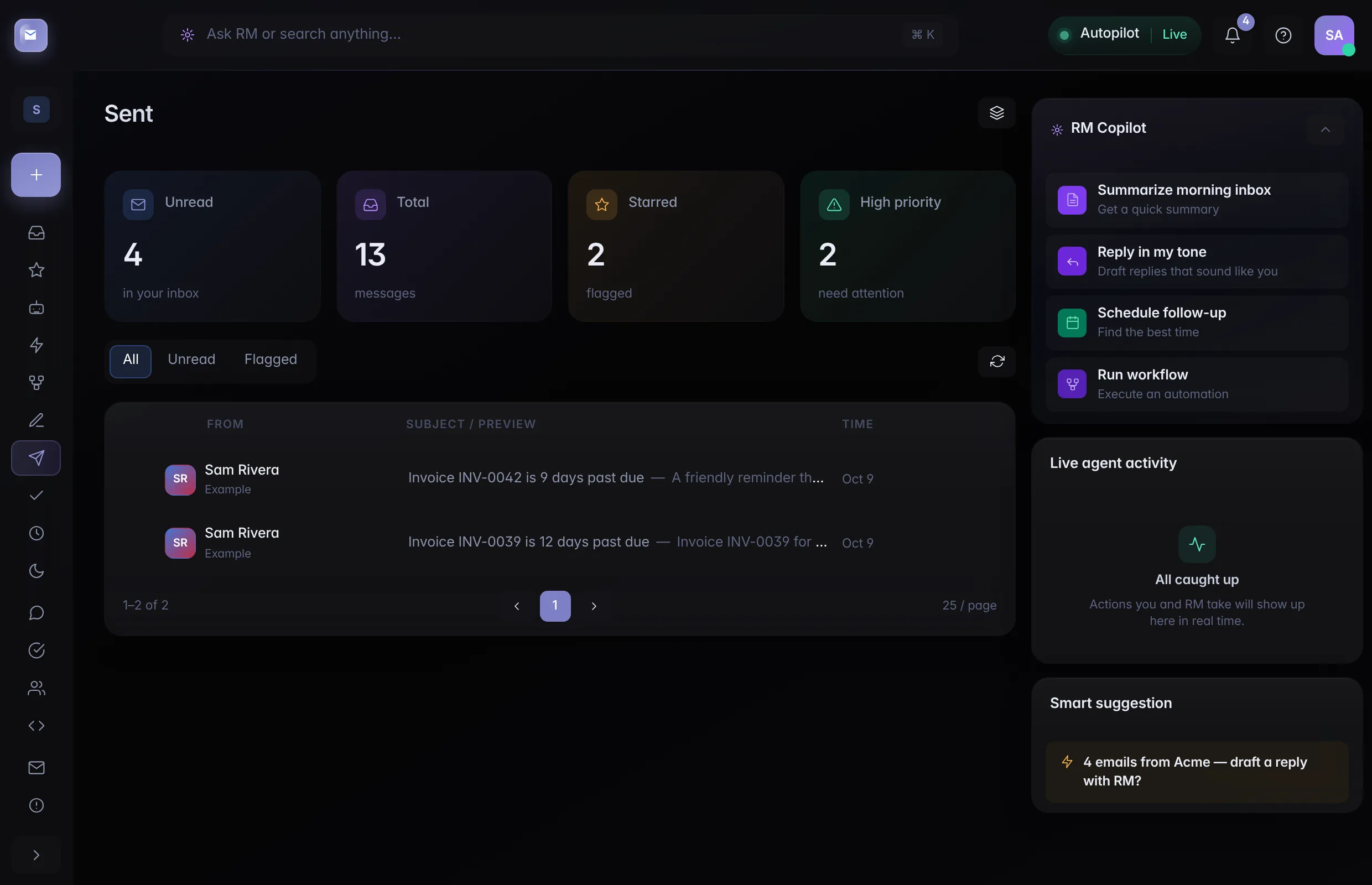
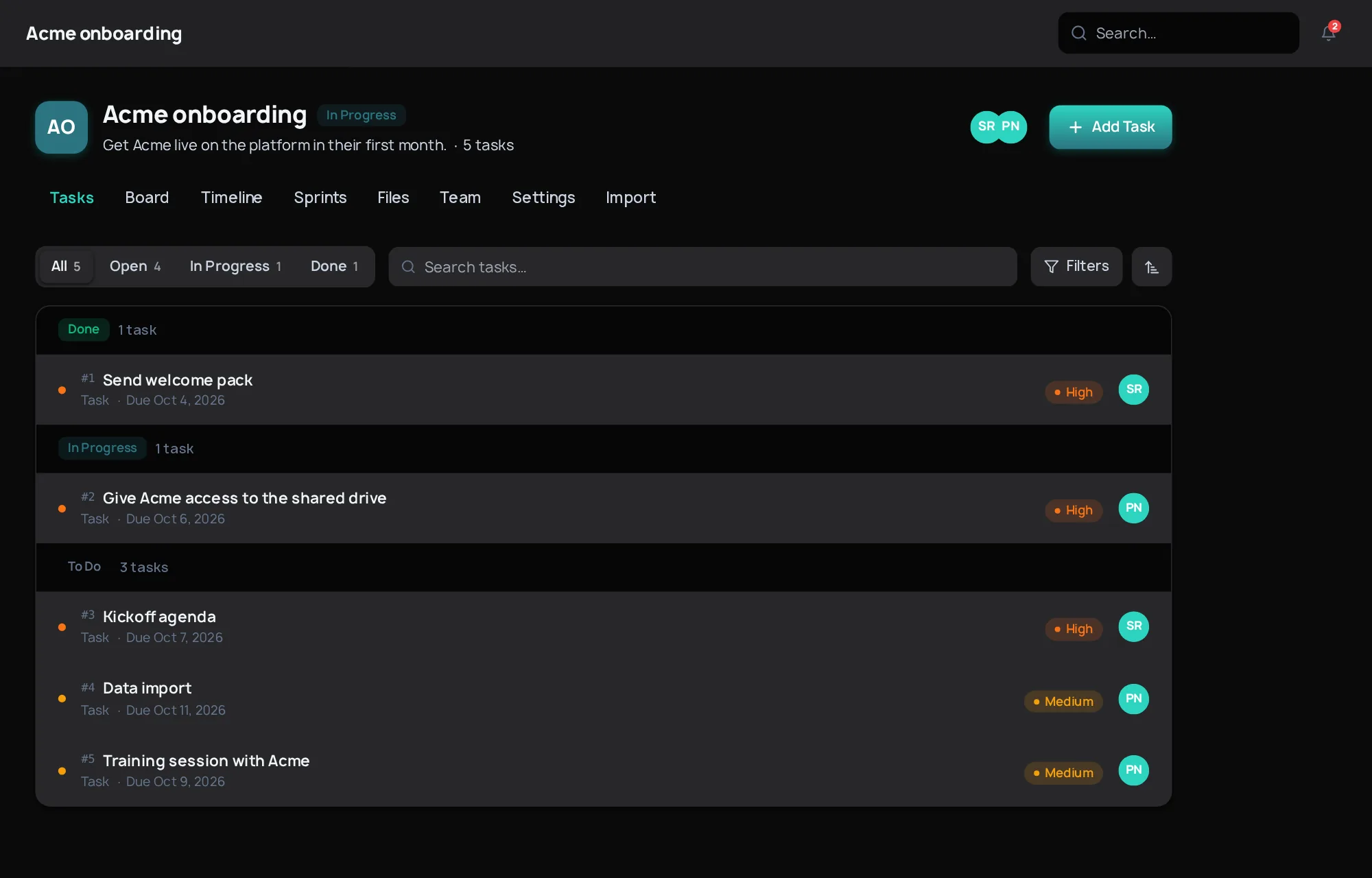
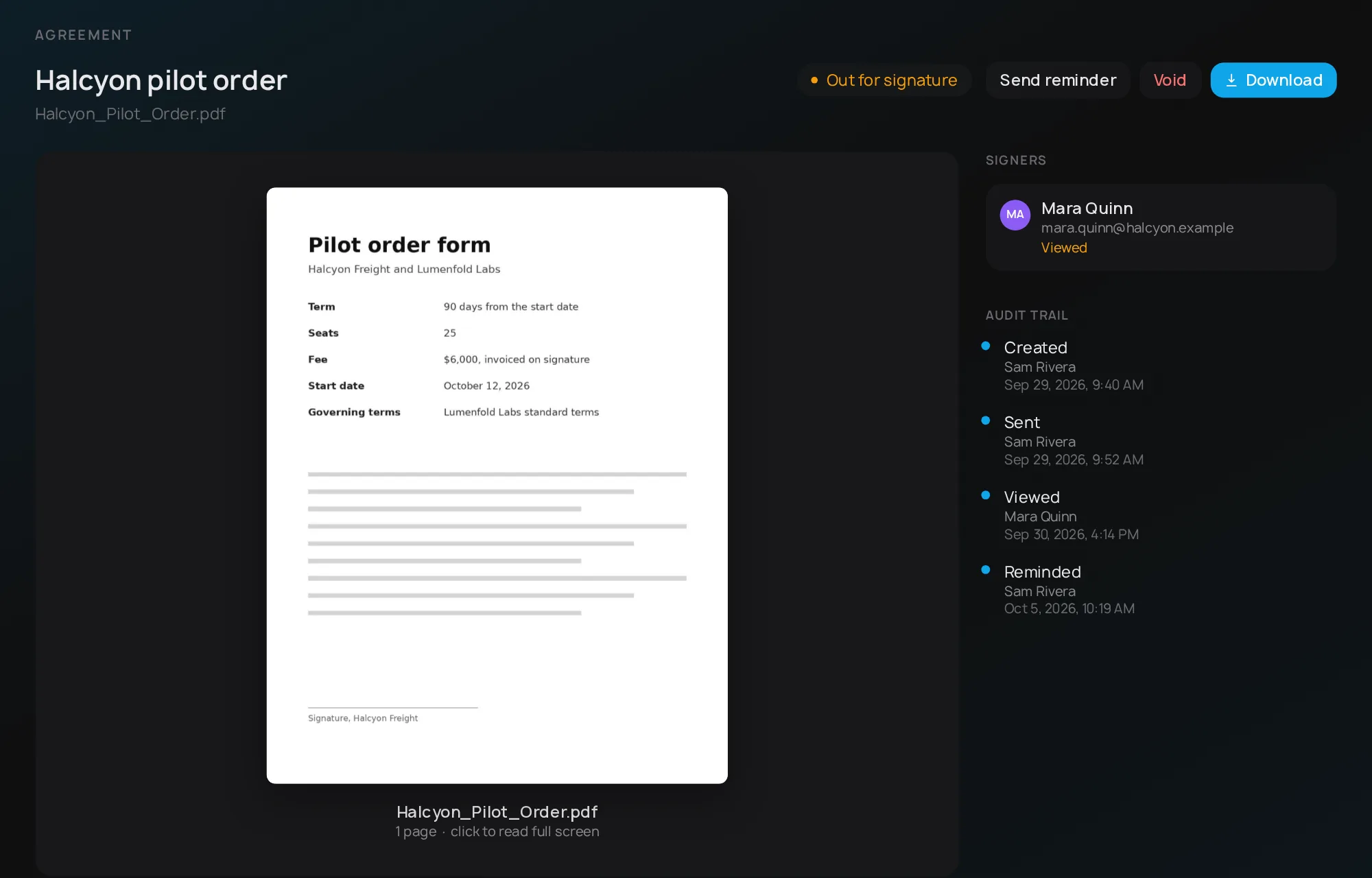
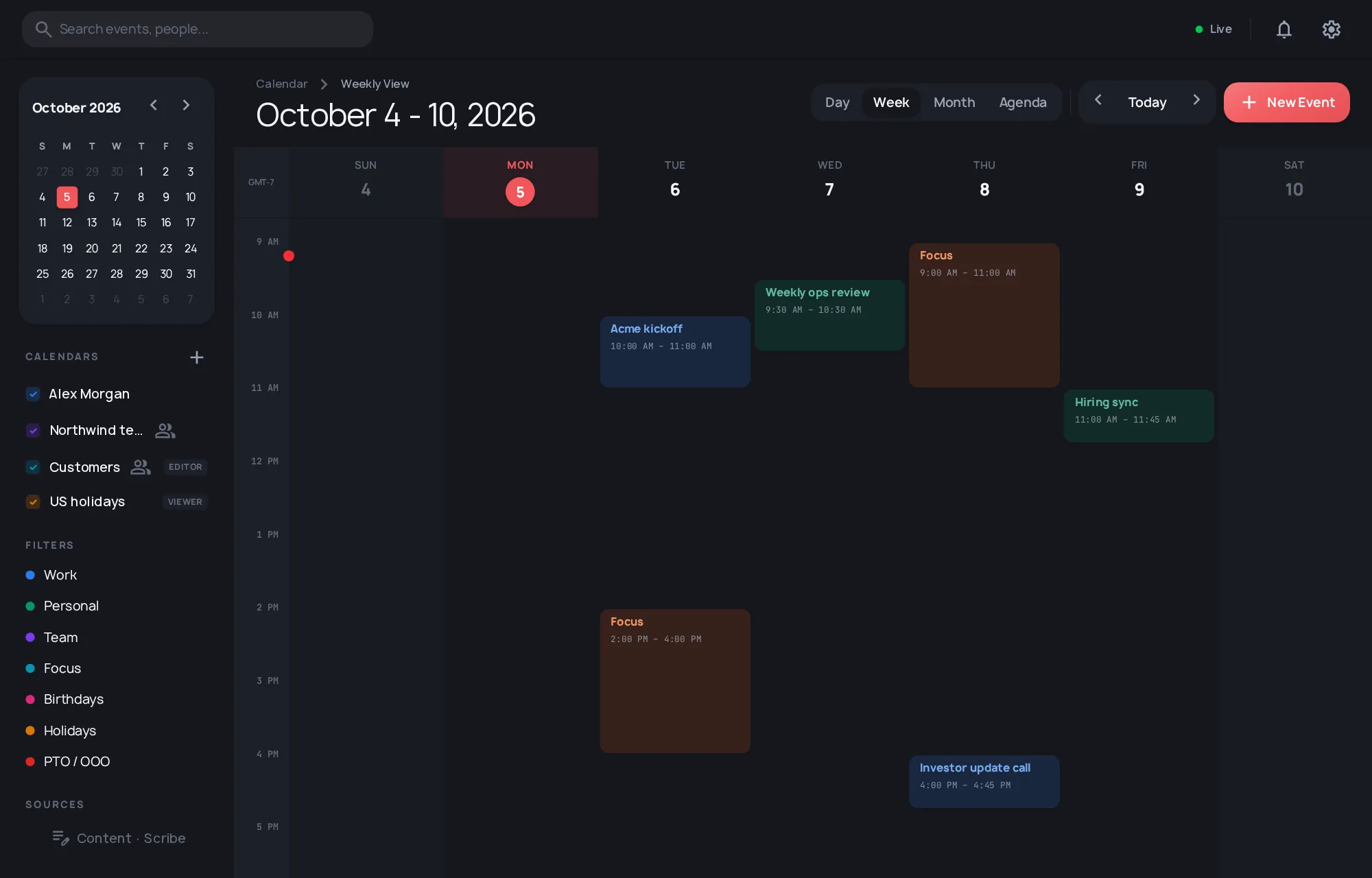
Captures of the real apps with sample data. The full day plays as a film on the landing page.
The suite
14 apps open today. 18 in design. One login, one data plane.
Build order is locked: the whole Operations suite first, then Productivity, Sales, Marketing, Legal, Ops Plus. Counted on the landing page's app board, 8 October 2026.
Where we are
The kernel is real. The company is pre-revenue.
Measured
On the eval harness with a hosted model: routing 11 of 11, tool choice 10 of 10 across three runs, two-turn follow-up 2 of 2 (31 Aug 2026). The same follow-up suite on a small local model scored 0 of 3, which is why the provider is the tenant's choice.
Not yet
No external tenant. No revenue. Early access is open on the landing page and every request is read by the founder. Sign-in, mail sending and the mobile shell are the open items in the first wave.
Business model
Seats are the floor. Credits grow with the work.
Seats
$10 to $20per seat per month, bring your own key
The tenant admin adds one key set for the whole company: Anthropic, OpenAI, Gemini, Bedrock, Azure, OpenRouter, Ollama, or any OpenAI-compatible endpoint. Managed AI, where we supply and hide the model, is a flat premium on the seat.
Credits
Pay as Blue worksa prepaid balance, drawn per action
Actions that use our services draw credits: the managed model's work, generated media, voice calls, signature envelopes, outbound mail. The admin tops up and sees every draw. Priced per action, never per token. The more of the company Blue runs, the more credits it earns.
Self-host
Same seat pricespackage alone, or with a model
A per-seat licence for companies that keep their data in their own building, pointed at a model they already run. Credits apply only to the services that still come from us.
Today each of these apps is sold on its own, per seat, by a different vendor. One seat here is the whole stack, and revenue per company rises as Blue takes on more of the day.
Market
Every company too small to have an IT team.
Beachhead: India and the US, English first. Then the UK and the EU, where the product already plans for data transfer rules.
- 1,97,692
- DPIIT-recognised startups in India, 31 Oct 2025 (Lok Sabha reply, 2 Dec 2025).
- about 5.8 million
- US employer firms under 50 staff, 2022 (KFF from Census data, secondary).
- about 1.4 million
- UK businesses with at least one employee, start of 2024 (Business Population Estimates, secondary sum).
- 32.4 million
- EU enterprises under 50 staff, 2023 preliminary (Eurostat SBS). Includes one-person firms.
Bottom-up, every assumption named
| Revenue per company | 8 seats × $15 × 12 = $1,440, plus credits at $10 a seat a month = $960, so $2,400 a year | assumption |
|---|---|---|
| Beachhead (TAM) | 6.0 million companies in India and the US × $2,400 ≈ $14 billion a year | upper bound |
| With the UK and EU | about 40 million companies, definitions mixed, × $2,400 ≈ $96 billion a year | upper bound |
| Serviceable (SAM) | 1 in 10 of the beachhead would move the whole stack ≈ $1.4 billion a year | assumption |
| 3 years (SOM) | 2,000 companies ≈ $4.8 million ARR | target |
| 5 years, venture case | 20,000 companies, 1 in 300 of the beachhead ≈ $48 million ARR | target |
Seats, price and credits are our planning figures, not survey data. The company counts are the only external numbers here, and their definitions differ by country.
Why now
Models can finally pick the right tool. They still should not be the glue.
Routing works
On our own eval a hosted model routes 11 of 11 sentences and picks the right tool 10 of 10 times. Two years ago this product could not be built. Today it can be measured.
Founders already talk to AI
The habit of saying what you want instead of clicking through it is formed. What is missing is a place where saying it changes the company's real records.
Any model, at the tenant's price
Model cost keeps falling and the tenant chooses the provider. We never carry the AI bill inside the product, so the margin does not depend on one vendor's pricing.
Competition
Everyone has an assistant. Nobody has the plane.
- The suites. Google Workspace, Microsoft 365, Zoho One own the apps. They were built app-first and the assistant was added to each app afterwards.
- The automators. Zapier-style tools and agent builders act across apps they do not own. No shared records, no plan to confirm, no trail.
- The copilots. An AI button inside one product knows one product.
- Supernatural owns the apps and acts across them, with a confirm step and an event trail on every change.
What compounds
The record of the company is the product.
The data plane
One entity graph and one append-only event log. The agent's memory is the company's own history, re-derivable from the log. Every new capability makes the graph denser.
The laws and the trail
Plan, confirm, cause recorded. A tenant can audit every action Blue took and why. That trail is what lets a founder switch more of the matrix on over time.
No model lock, own hardware
Bring your own key means no vendor can reprice us. Tenant data lives on hardware we run in India, and the compliance playbook is written down and public.
Go to market
Founders first, in the open.
We have built far more than we have sold. The plan for the next twelve months is a sales motion, not another suite.
- Early access, nowThe landing page is a film of the product. Each request tells us the first sentence a founder would hand to Blue.
- Ten design partnersFounder-led companies of 2 to 50 people, India and the US, on the Operations suite. Weekly calls. Their sentences become the eval set.
- Self-serve per seatBring your own key removes the AI cost objection. Billing and sign-up open once the first partners run a full month.
- First sales hireFunded by this round. Outbound to founders, built on the product's own CRM and mail.
Roadmap
Operations first. Then everything a company does.
Now · wave 1
Operations
Calendar, chat and meetings, mail, files, projects, credentials, e-signature, budget and invoices, tickets, timecards, sign-in, search. Twelve capabilities, one login.
Next
Productivity, then Sales
Documents, sheets, decks and charts as editors over the same files. Then the CRM, voice reps and call intelligence on the same contacts.
Then
Marketing, Legal, Ops Plus
Content, motion graphics, opportunities. The rules that apply to the company. Payroll and HR run from the roster.
Milestones in order, not on dates: early access open · first paying tenants and billing · self-host package · mobile shell. Each one is a gate, not a quarter.
Team
Two founders who build in the open.
Sasi Preetham R, founder. Harshavardhan Malla, founder. Together they design and build the product, with AI coding agents doing the typing. Every change is in the repository history: 782 commits since 23 April 2026.
Rang & Mall Private Limited, incorporated 13 January 2026, Visakhapatnam, Andhra Pradesh. The same company runs a family of live products for founders, which is where the Operations suite's reference implementations came from.
How the product gets built
- One repository. Kernel in FastAPI, one Postgres, a React shell. Forced row-level security from the first migration.
- Rebuilt, not ported. The live apps stay standalone. Supernatural builds its own versions with one design system and one data plane.
- Compliance written first. Every product follows a public playbook: what is stored, where, for how long, and how to have it deleted.
The ask
A seed round to sell what is built.
Round size on request. Write to [email protected].
Eighteen months of runway to take the Operations suite from early access to paying tenants, and to put the first salesperson in front of founders.
Use of funds
- 50%Engineering: finish wave 1 (sign-in, mail sending, mobile shell), then Productivity.
- 30%Go to market: first sales hire, design partners, the public film and docs.
- 20%Infrastructure and compliance: a data house per tenant, UK and EU transfer tooling, backups proven by restore.
Thank you
Start with one sentence.
What is the first thing you would hand to Blue?
Supernatural by Rang & Mall Private Limited · Privacy · Compliance playbook